City vs county permit records are separated by the government that had authority over the property and the work when the permit was handled. A county assessor page can identify a parcel anywhere in the county, but that does not mean the county issued the building permit. For a site inside an incorporated city, start with the city building department. For an unincorporated site, start with county permitting. Then verify contract services, annexation history, trade-permit agencies, and older archives.
The practical goal is not to pick a portal from the mailing address. It is to build a short evidence trail: exact parcel, service area, issuing agency, permit number, scope, issue date, current status, inspections, and final approval. If one of those links is missing, the search is not finished.
Reviewed July 22, 2026. This is a public-record research method, not a determination that work was legal, complete, or approved. Local boundaries, contracts, databases, and retention schedules change.
Why the county name can send you to the wrong office
Property tax administration and construction regulation often sit in different agencies. A county assessor may maintain the parcel number and ownership record for property inside cities and unincorporated areas alike. Building permits, however, may be issued by a city department, a county division, a regional partner, or a contracted agency. The assessor is useful for identifying the land; it is not automatic proof of the permit authority.
Mailing addresses create another trap. A postal city name can be familiar and convenient without proving that a parcel lies inside that municipality’s legal boundary. Start with the parcel identifier and an official jurisdiction or service-area source. The USA.gov local-government directory can help locate official government sites, but the local planning or building office must confirm who serves the property.
King County’s official records guidance gives a concrete example. It says properties within city limits generally require contacting the city, while the county researches permits for unincorporated King County. It also warns that the county may retain some permits finalized before a property was annexed or incorporated. That one exception explains why both the current boundary and the permit date matter.
Route the property to the correct office
Use the full address and parcel number to answer one question before opening a permit portal: which government controlled this kind of work at this location on the relevant date? The starting route is simple, but each route has exceptions worth recording.
| Check | Inside an incorporated city | Unincorporated area |
|---|---|---|
| First permit office | City building, planning, or development department | County permitting or local-services division |
| Parcel record | Use the county parcel number to identify the site; do not treat it as proof the county issued permits | Use the parcel number to match the site and county service area |
| Current records | Search the city’s official portal by address and permit number | Search the county’s official permit database or records center |
| Older records | Check the city archive, document library, microfilm, or predecessor system | Check county archives and whether a later annexation split the history |
| Exceptions | Verify contract services and separate fire, electrical, health, or utility authorities | Verify special districts, state work, and agencies outside the county building office |
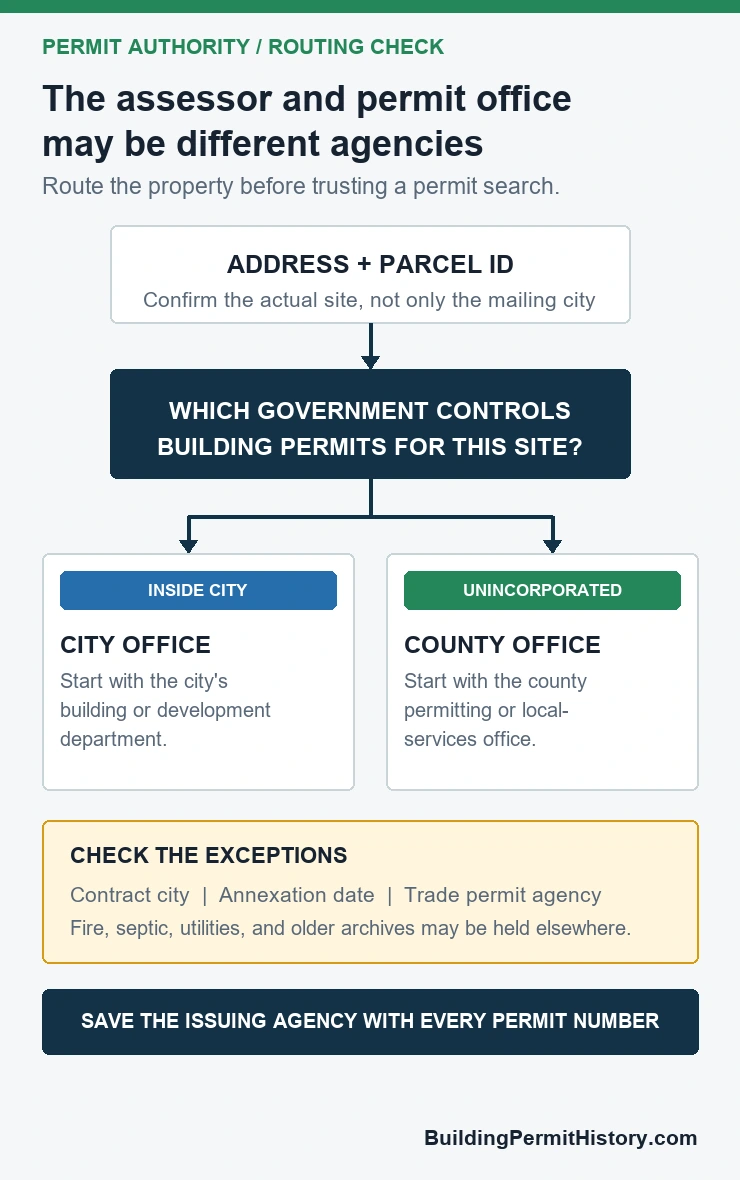
The King County permit-record research page states that records for properties inside cities such as Seattle or Bellevue usually require the city, not county permitting. Its permit service page describes county land-use, building, and fire services for unincorporated areas. Those are service-area statements, not merely links to two interchangeable search boxes.
When the location is elsewhere, repeat the same method with that jurisdiction’s official boundary and agency pages. Our official permit-source directory is a routing aid, and the property permit city-or-county guide covers the initial choice. The final evidence must still come from the issuing authority.
Read one real city permit record
The City of Seattle publishes a Building Permits dataset covering issued or in-progress permits within Seattle. Its official catalog metadata identifies the data as Public Domain and describes a daily refresh. A row is useful because it exposes the fields a researcher should preserve instead of relying on a search-results count.
- Location: 10001 57th Ave S, Seattle, WA 98178
- Permit: 6972649-CN
- Type: building, new, non-residential
- Dates: applied July 14, 2025; issued April 21, 2026
- Current dataset status: issued
- Scope: a new institutional-building expansion with mechanical work included
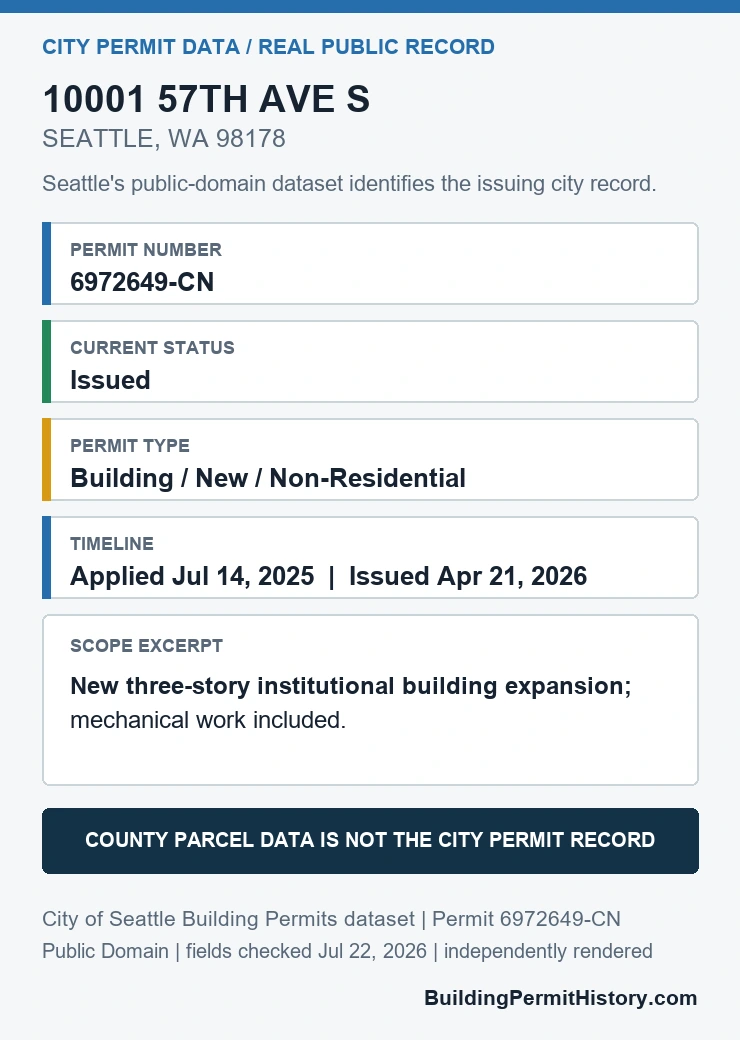
The record demonstrates three limits. First, the permit number and issuing city belong together. Second, “issued” does not by itself mean every inspection is complete. Third, the scope must be compared with the work visible at the property. Use the permit-number lookup guide to follow related records, and check the separate final-inspection status before describing a project as finished.
Seattle’s project and property research guidance explains that current activity, historical documents, maps, and older systems serve different purposes. It directs current permit searches to the Seattle Services Portal and describes additional document and microfilm resources. A dataset row is a starting record, not a substitute for the live detail, inspection history, or underlying documents.
Search the current portal and the archive separately
A blank current search does not prove that no permit ever existed. The record may predate the portal, use an old address, sit under a parent permit, or remain in a scanned archive. Search the normalized address first, then the parcel number, permit number, prior address, and owner-independent legal description if the official system supports them.
- Record the exact current address and parcel number from official property data.
- Confirm the current city boundary or unincorporated service area.
- Search the current issuing agency by address and permit number.
- Open every related record and compare scope, dates, status, inspections, and documents.
- Repeat the search in the named legacy portal, archive, or records library.
- If the property changed jurisdiction, search both agencies using the permit date as the dividing line.
The old building-permit lookup explains archive routes, while Address Not Found in Permit System covers formatting, parcel, and legacy-address failures. Do not turn a database limitation into a factual conclusion about the property.
When two systems return records for what appears to be the same project, compare rather than merge them by guesswork. Match the address, parcel, applicant-independent scope, issue date, parent permit, and related-record links. One row may be a planning application, another the construction permit, and others the electrical or mechanical permits. A replacement database may also carry a migrated summary while the legacy system holds the inspection detail. Keep both URLs and note which field came from which authority. The step-by-step building-permit records check can be used as a neutral worksheet for this comparison.
Keep the issuing agency attached to the evidence
Save enough context for another person to repeat the search. A screenshot with only a permit number can become meaningless after a portal redesign. A stronger note includes the agency name, official URL, search date, property identifier, permit number, work description, status language, key dates, related permits, inspection result, and any document-request reference.
Keep the authority’s exact status wording. “Application,” “under review,” “issued,” “expired,” “closed,” “finaled,” and “certificate of occupancy issued” are not synonyms. The permit-record fields guide explains what common entries can and cannot establish, and the certificate of occupancy comparison separates permission to construct from approval to occupy.
For a purchase or renovation decision, connect the permit to the physical work. Compare additions, structural changes, bedrooms, electrical service, plumbing fixtures, mechanical equipment, and occupancy with the recorded scope. Our open-permit check before buying and unpermitted-work records checklist show how to escalate a mismatch without claiming that an absent online record proves a violation.
Handle contract cities, annexations, and split authority
The city-versus-county choice is a starting rule, not a universal organizational chart. A city may contract with a county or another jurisdiction for plan review or inspections. Fire, septic, health, utilities, elevators, and state-regulated work may sit outside the general building portal. Electrical, plumbing, and mechanical records may also be separate or linked as child permits; the trade-permit records guide explains that second search.
Annexation creates a time split. A parcel can be inside a city today while older county permits remain in the county archive. Conversely, later city permits may not appear in the former county system. Record the effective date of the boundary change if the agencies mention one, then ask which office retained pre-annexation files. The King County page specifically notes that its records center may hold some finalized records for properties later annexed or incorporated.
Also check the coverage date and omissions disclosed by each source. Data exports can lag live portals, scanned files can omit searchable text, and a summary row may exclude inspection documents. The building-permit data limitations page gives a framework for recording those gaps instead of quietly treating them as “no record.”
What to ask when the search returns nothing
Contact the likely records office with a narrow, reproducible request. Avoid asking only, “Are there permits?” Give the current address, parcel number, prior address if known, approximate work date, project type, and the systems already searched. Then ask:
- Was this parcel inside your permit jurisdiction on the date of the work?
- Did another agency or contract jurisdiction issue this permit type?
- Is there a predecessor portal, microfilm index, scanned archive, or public-records request route?
- Could the record be filed under a parent permit, former address, parcel split, or merged development site?
- Which record shows final inspection or occupancy, and how can a copy be requested?
Write down the office, date, and response. If the answer is verbal and the decision carries financial or safety consequences, ask whether the agency can identify the governing page, record number, or written determination. Also ask whether its search uses today’s address, the address recorded when the permit was issued, or both; that detail can explain an otherwise empty result. A clean audit trail is more useful than repeatedly searching the same incorrect portal.
Questions to settle before relying on the record
Does a county assessor result mean the county issued the permit?
No. The assessor result identifies the parcel for tax and property-record purposes. Confirm the building-permit service area and issuing agency separately.
Should I search both city and county?
Search both when the jurisdiction is uncertain, the parcel was annexed, the work date crosses a boundary change, or the local guidance says services are contracted or divided. Do not treat duplicate or missing results as equivalent without matching permit numbers and dates.
Is an issued permit proof that the work passed final inspection?
No. Issuance authorizes covered work under the permit. Check the inspection history, final status, related trade permits, and any required certificate of occupancy.
What should I save from an online search?
Save the issuing agency, official URL, search date, address and parcel, permit number, scope, status, dates, related records, inspection result, and source limitations. Those details let another person reproduce the check after the portal changes.