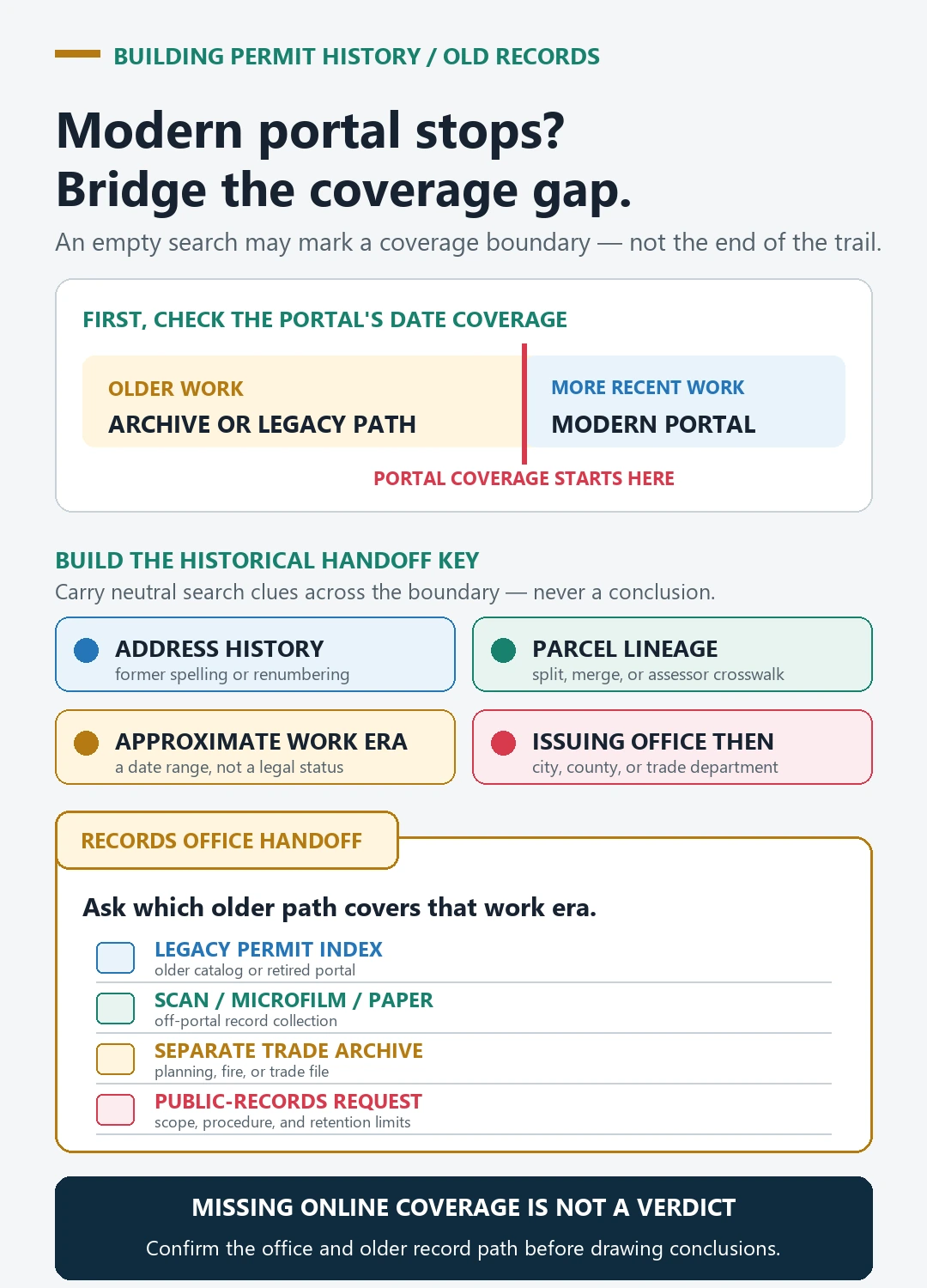
An old building permit lookup begins by identifying the likely record era and storage system. Search the current official database, but treat its published start date as a boundary rather than a promise of complete history. If the work predates that boundary, use the permit number, address aliases, parcel clues, and a narrow records request to reach scanned files, paper indexes, microfilm, plans, or inspection cards.
Official route checked August 26, 2026: San Francisco Department of Building Inspection. Recheck DBI’s stated online era, property identifiers and current records-request instructions before concluding an older San Francisco file is absent.
Estimate the work era before searching
Start with a defensible time band. Deeds, assessor descriptions, historic maps, directories, dated photographs, utility changes, architectural features, and prior owner documents can suggest when an addition or conversion appeared. These are discovery clues, not proof that a permit existed. Write the earliest and latest plausible years and explain why each date was chosen.
Also list the record families the work could have created. A rear addition may have a building application, approved plans, electrical and plumbing permits, job cards, inspections, and a certificate. A storefront change may involve building, fire, planning, sign, or occupancy records. This family list makes an archive request specific enough to search.
Test the official online window first
San Francisco’s Department of Building Inspection operates the Permit or Complaint Tracking System. The official page says it covers building, electrical, plumbing, and boiler permits plus complaints, and that its online permit records reach back to the 1980s. It offers searches by site address, permit application or complaint number, applicant, keyword, and city map.
That statement defines the online layer, not the beginning of all city records. Search the current address first. Then try a permit number, former address, applicant name, or distinctive scope keyword if one is available. Capture the exact query and the selected result URL or number. A result from the wrong lot or a similarly numbered building is not evidence for the subject property.
The building permit history by address guide can help organize multiple address forms without merging neighboring parcels.
Follow identifiers, not just street text
Older records often survive under an identifier even when an address search fails. Copy every application number, permit number, block and lot, complaint number, certificate reference, applicant, and date shown in a plausible result. Search each identifier separately and note whether it leads to a detail page, image, related record, or only a summary row.
An address can change through renumbering, street-name changes, corner-address selection, subdivision, condominium creation, or lot consolidation. Keep the former and current forms in separate columns. If a city index uses block and lot, verify that combination against the subject parcel before accepting a record. The goal is a traceable identity bridge, not a large pile of nearby permits.
Choose the historical record family deliberately
The current San Francisco DBI Records Request Form shows the record families that can be requested. It includes original building permits, building permit applications, electrical permits, plumbing or mechanical permits, notices of violation or complaints, job cards or inspection history, certificates of final completion, specific application records, and records within a date range.
Use that menu to formulate the request. If you know an application number, ask for the specific document family tied to it. If you know only the era, provide a narrow date range and the property’s current and former address plus unit, floor, corner status, and block or lot where available. Requesting every record without an era or type can slow the search and make the returned file harder to interpret.
Separate plans from permit summaries
A database summary may show that an application was filed or issued, but it may not show the dimensions, rooms, structural work, or approved revisions. The San Francisco form states that building-plan requests are for viewing first in the office and describes a separate duplication process. Therefore, do not tell a user that a brief online description is equivalent to the approved drawing set.
When plans matter, record the application number and ask whether the original set, revisions, or both are available. Note copyright, ownership affidavit, viewing, and copying requirements communicated by the authority. If the plan cannot be copied, document the visit date, sheet identifiers, and the specific scope features observed without photographing restricted material.
Read historical metadata cautiously
An upload date can be decades later than the document date. A scanned card may summarize several inspections in cramped notation. A permit index may use an issue year while the work finished later. Preserve the label beside every date: application, issue, inspection, completion, scan, or upload.
Likewise, absence of a final certificate in one folder is not automatically proof that no closeout occurred. Search the inspection or job-card family and any certificate index. The building permit records guide explains which fields answer proposal, authorization, inspection, and completion questions.
Escalate a no-hit with a bounded request
Before contacting records staff, save a short failure log:
- official systems checked and their stated date coverage;
- current and former address forms;
- block, lot, parcel, or other property key;
- approximate work years and record families sought;
- candidate permit or application numbers;
- exact error, blank result, or mismatch encountered.
Then ask whether the relevant era is held in paper files, microfilm, scanned permit cards, another department, or an off-site archive. A useful question names the property, era, and document family. It does not ask staff to determine whether all past work was lawful.
Assemble a historical evidence packet
Keep a cover sheet with the authority, property identity, search date, online-window statement, systems queried, request number, and records received. For each document, record its original date, document type, permit identifier, named scope, inspection or completion notation, and any missing page or illegible field.
End with a bounded finding. You may be able to say that an archived application and job card support a permitted addition within a certain date range, while approved plans were not retrieved. You should not say that a blank online result proves no permit ever existed. For genuinely old work, the quality of the lookup comes from connecting the current property to the correct archive layer and preserving the limits of what that layer returned.