To look up a building permit by address, start with the city or county department that issued permits for the property. If you do not know the agency, use the USA.gov local government directory, then open the building, planning, development services, or inspections department’s official site. Search with the official street address first. Also have the parcel number (APN, PIN, or similar local identifier), building identifier such as a New York City BIN, permit or application number, approximate work date, and owner or contractor name when available.
Your next action is to open every plausible individual record, not stop at the result list. Compare the property address, work description, issue date, permit number, inspection history, and final or closed status. Save the issuing agency and stable record number with the result. If the first search returns nothing, normalize the address, try the parcel identifier, check the agency’s legacy system, and then ask its records office for the missing period.
This guide explains the search process; it is not a government database. It cannot establish whether work was lawful, complete, or code-compliant. For a jurisdiction-specific starting point, use the Building Permit Official Sources Directory.
Identify the issuing department before you search
A permit record is owned by the jurisdiction that reviewed the work. The correct source may be a city building department, county development office, consolidated planning agency, or a contracted regional portal. A postal address alone does not prove jurisdiction: properties near city boundaries may use a city mailing name but fall under county authority.
- Confirm whether the parcel is inside city limits and note the issuing department’s exact name.
- Copy the address exactly as the assessor or official property page formats it, including directionals and unit numbers.
- Collect a stable parcel or building identifier before changing search terms.
- Set an approximate work-date range so you can identify records that may live in an older system.
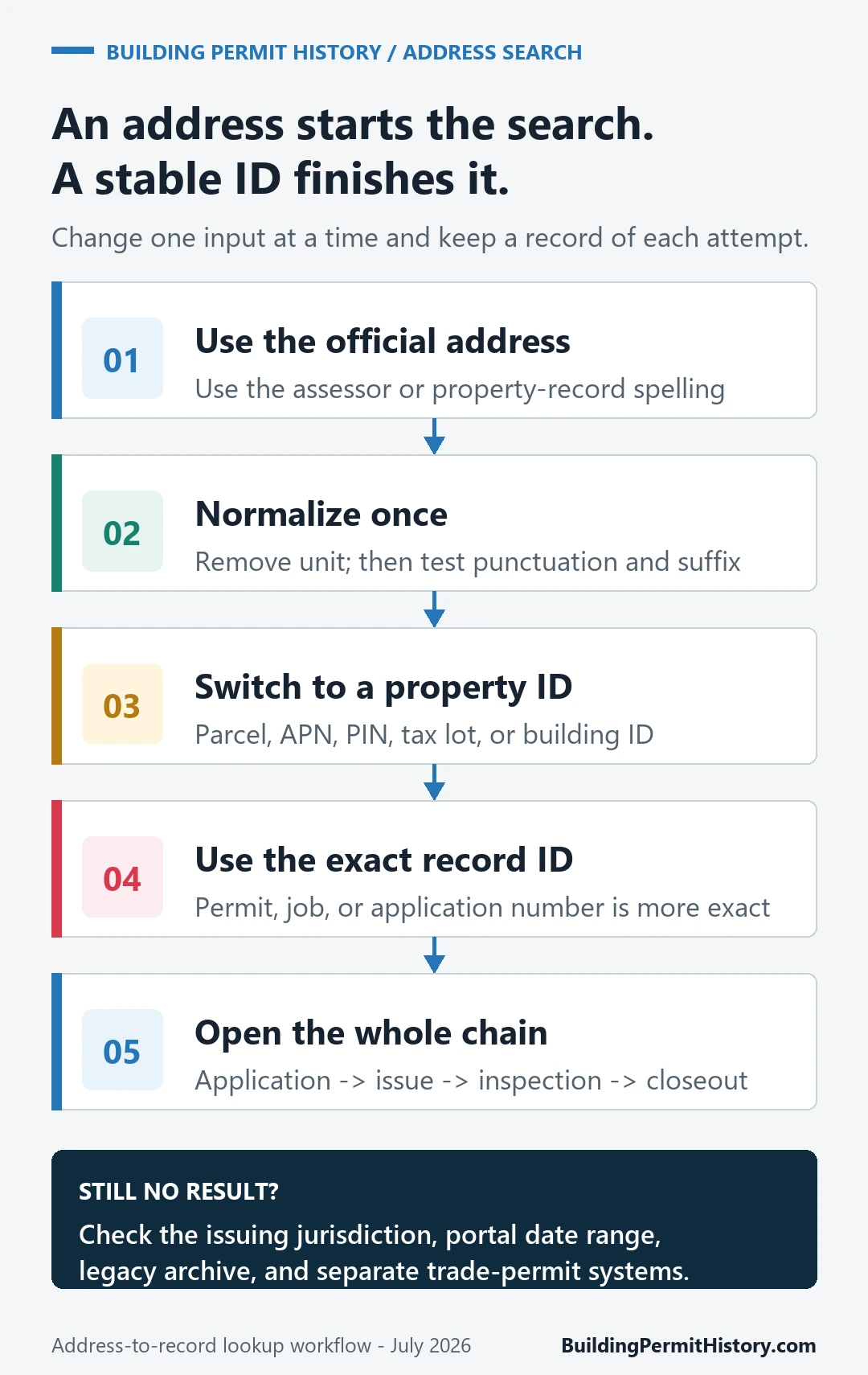
Search the address, then move to a stable identifier
- Start broad but exact. Enter the official house number and street name. Leave the unit blank unless the portal requires it.
- Normalize once. If there is no match, remove punctuation, try the directional in full and abbreviated forms, and test the base address without a unit.
- Switch to the parcel or building ID. An APN, PIN, parcel ID, or BIN is usually more stable than spelling and unit formatting.
- Open each record. A summary row may omit inspections, amendments, certificates, or closeout documents.
- Build a record chain. Link the application, issued permit, revisions, inspections, correction notices, final approval, and certificate when the portal provides them.
Do not assume that a record-number search and an address search cover the same years. Some agencies separate current applications from historical permits, archived cards, scanned plans, or public-records requests.
Seattle example: address and record-number search
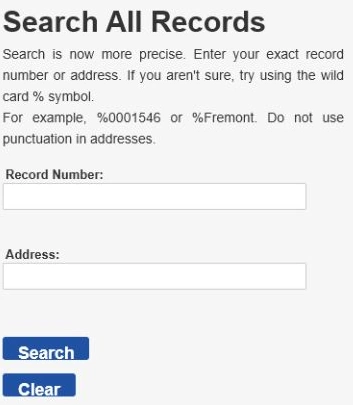
Seattle SDCI’s Research a Project page routes users to the city’s official research tools. In the Seattle Services Portal Search All Records form, use an exact record number when you have one or the address fields when you do not. The form’s own instruction says not to use punctuation in addresses.
New York City example: current and legacy records can be separate
New York City demonstrates why one empty result is not the end of a search. Start with NYC Department of Buildings’ Building Applications & Permits and Find Building Data pages. NYC DOB explains that filings may be divided between DOB NOW and the legacy Buildings Information System (BIS). Use the address, borough, block and lot, BIN, or job and permit number supported by the relevant system.
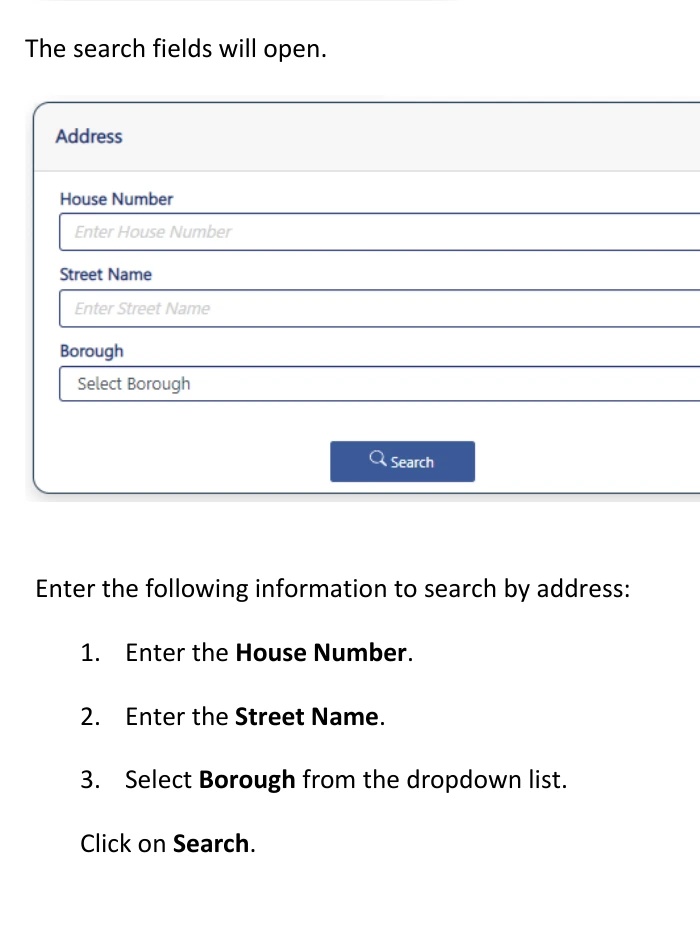
For each NYC match, preserve the issuing system, official address, borough-block-lot or BIN, job or permit number, work type and description, filing and issue dates, applicant or contractor when shown, inspection results, sign-off or final status, and any certificate of occupancy reference. The same evidence discipline applies elsewhere even though field names differ.
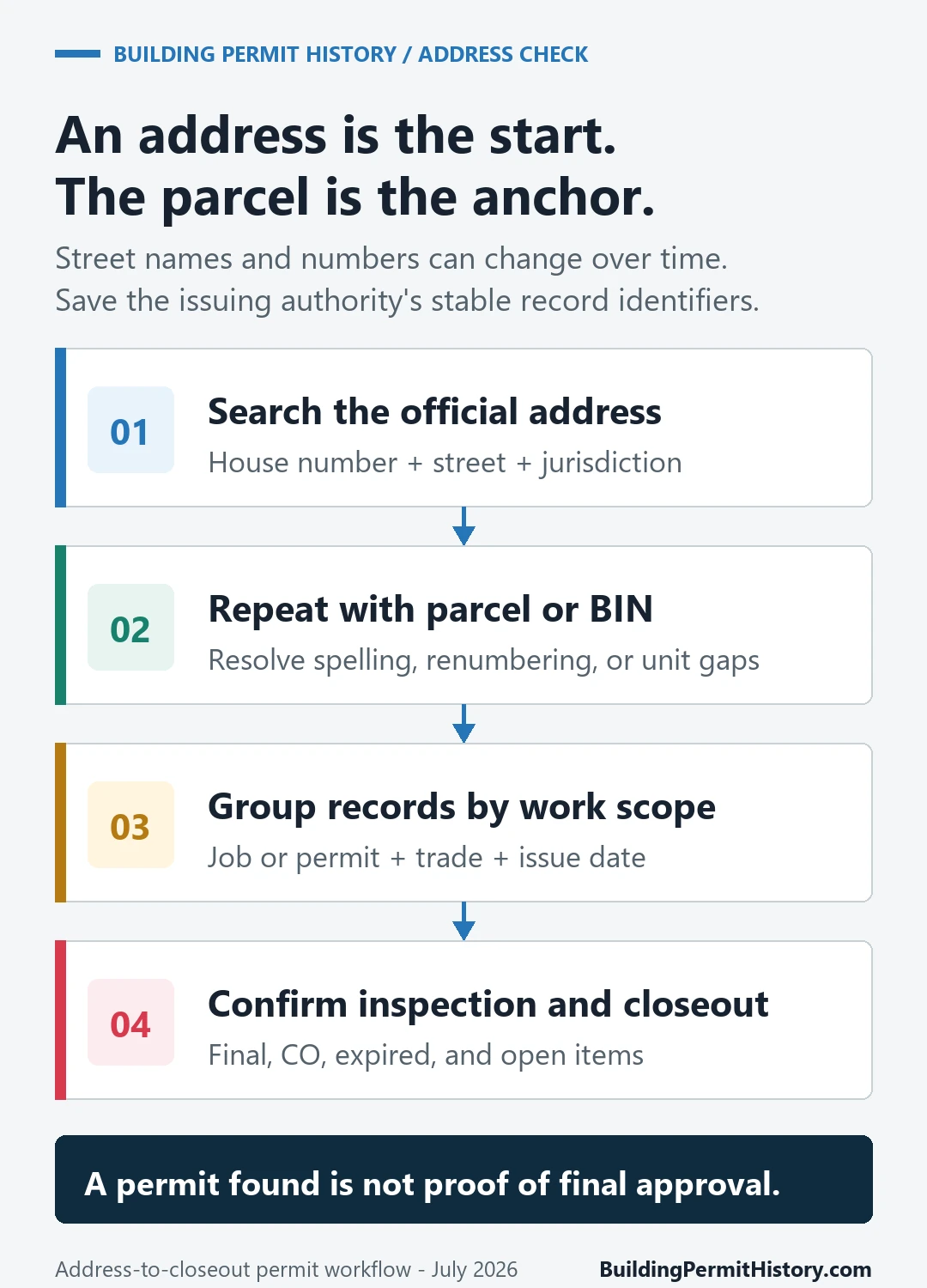
What to record from each permit result
- Identity: issuing agency, portal or database name, address as displayed, parcel or building identifier, and permit or application number.
- Scope: work description, permit type, valuation if shown, and related applications or revisions.
- Timeline: application, issue, expiration, inspection, final, and certificate dates.
- Outcome: issued, active, expired, withdrawn, revoked, finaled, closed, or other local status, copied exactly rather than reinterpreted.
- Evidence: the official record URL, retrieval date, downloadable documents, and the name of the office to contact for omissions.
An issued permit alone is insufficient to show that all required inspections passed. A final inspection does not necessarily answer every occupancy, zoning, fire, electrical, plumbing, or historic-review question. Read the agency’s definitions and look for linked records before drawing a conclusion.
No-result recovery checklist
- Verify the jurisdiction and spelling against an official assessor, parcel, or address source.
- Retry without punctuation, unit, ZIP code, street suffix, or directional; then try the locally preferred form.
- Search by parcel, APN, PIN, BIN, block and lot, permit number, or application number.
- Check whether the agency divides current and legacy records by year or system.
- Look for open-data downloads, scanned permit cards, archive indexes, or a public-records request page.
- Contact the records custodian with the address, parcel ID, work-date range, owner names, and the exact systems already searched.
Keep a short search log. Record the system, search field, value, filters, date searched, and result. That makes a no-result finding reproducible and prevents a portal outage or formatting mismatch from being mistaken for proof that no permit exists.
Local guides and next steps
Use a local guide when the issuing jurisdiction is known: New York City, Chicago, Los Angeles, Seattle, Austin, or Pima County. These links route to separate city or county guides; their content is not reproduced here.
If you already have a record identifier, continue with the permit number lookup guide. For older work, use the old building permit lookup guide to plan the archive and records-office step.
Limitations and source verification
Online coverage varies by jurisdiction, record type, and year. Address changes, parcel splits and merges, unit renumbering, migration gaps, exempt work, and separate trade-permit systems can all produce incomplete results. Portal data can also change after retrieval. For a purchase, dispute, property-condition decision, or formal conclusion, confirm the record with the issuing agency and obtain certified or complete records when appropriate.
Last verified: August 31, 2026. The page’s routing instructions and official source links were reviewed on that date. The preserved Seattle and NYC image captions retain their own July 22, 2026 source-check dates. Those older caption dates describe when the pictured source material was checked; they are not a claim that a live portal screen was re-captured or guaranteed unchanged on August 31.