To find open permits on a house, first identify the city or county building department that issued permits for the property. Search the exact address and parcel number, open each permit’s detail page, and look for the inspection and close-out events tied to the same work. A status label alone does not tell you whether the work was finished properly.
There is no nationwide house-permit database or universal meaning for “open.” One portal may use active, issued, pending, expired, finaled, completed, or closed, while another splits older and newer records between separate systems.
Find the issuing department before you search
Permits are usually held by the local government with jurisdiction over the address. Start with the official building, planning, or development-services website. A commercial property-data site can help with an address, but it is not the authority that issued or closed the permit.
- Use the USA.gov local-government directory if you do not know the responsible city or county.
- For New York City, begin with NYC Find Building Data, which routes older BIS records and newer DOB NOW filings.
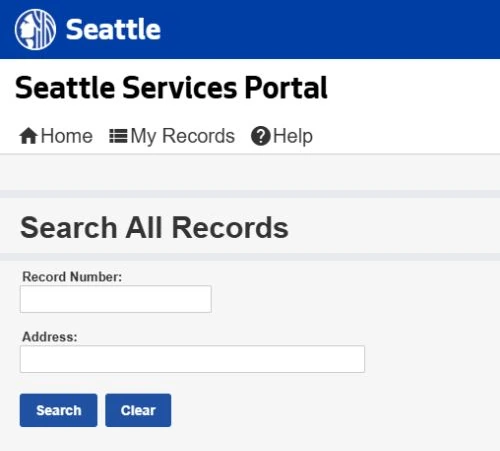
- For Seattle, use the city’s property research guidance and the Seattle Services Portal record search.
- Austin Development Services provides a public-search walkthrough showing permit-number and property-search routes.
Check the authority’s date coverage before assuming the search is complete. NYC, for example, tells users to use both BIS and DOB NOW because filings created in DOB NOW do not appear in BIS.
Search the address, then the parcel number
Begin with the street address exactly as the authority formats it. If the result is empty or shows only part of the property, repeat the search with the parcel, assessor, block-and-lot, BIN, or APN used in that jurisdiction. Multi-address buildings and corner lots are often easier to match by parcel identifier.
- Exact street number, street name, suffix, and unit when the portal accepts one
- Parcel, APN, assessor, block-and-lot, or building identification number
- Permit, application, job, or record number if it appears on plans or invoices
- Approximate work date, permit type, contractor, owner, or applicant as secondary filters
Do not filter by “open” on the first search unless the portal requires it. A permit may be listed under an unexpected status, a related trade record, or an older system, and an early filter can hide the record you need.
Open every permit tied to the same work
A property summary or permit count is only the starting point. Open the detail page for each record that matches the renovation, addition, roof, electrical, plumbing, mechanical, demolition, or occupancy work you are checking.
- Confirm the property. Match the address, parcel, and issuing jurisdiction before reading the status.
- Match the scope. Compare the permit description, type, issue date, and contractor or applicant with the work visible at the house.
- Follow related records. Structural work may have separate electrical, plumbing, mechanical, fire, planning, or right-of-way permits.
- Read field events. Look for scheduled and completed inspections, failed or partial inspections, correction notices, outstanding documents, and unpaid fees.
- Find the close-out evidence. Depending on the authority, this may be a final inspection, finaled status, letter of completion, certificate of occupancy, or another named record.
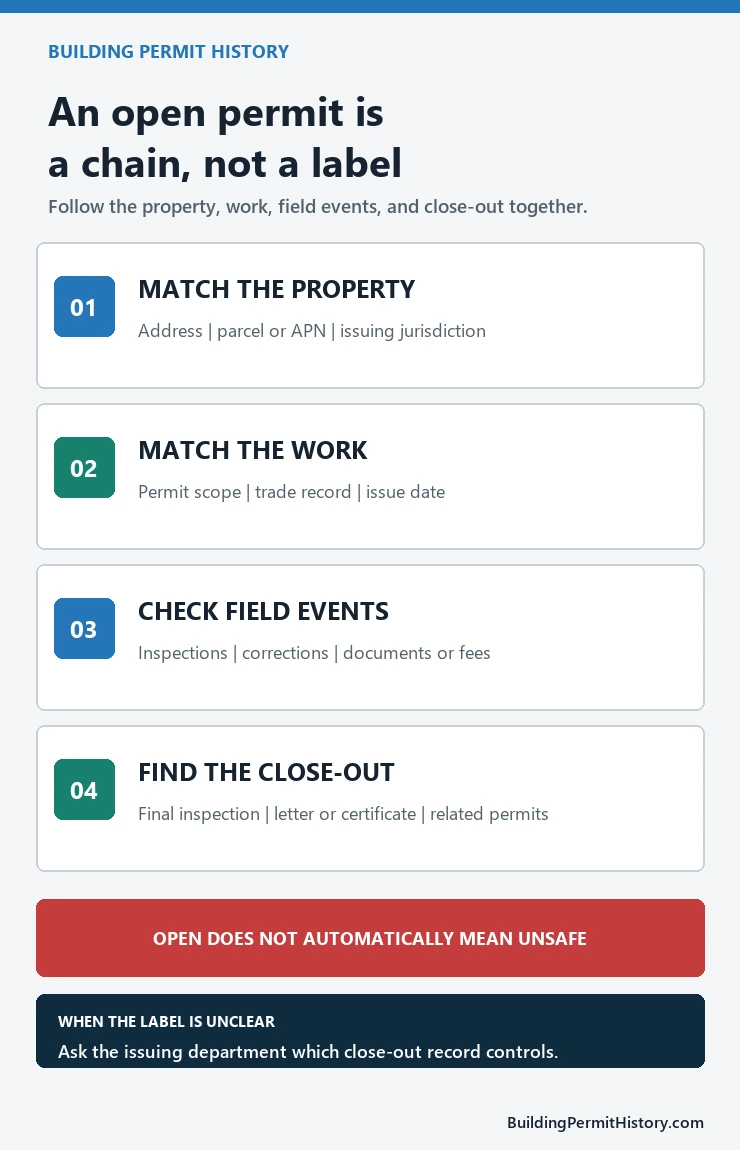
Save the permit numbers and the name of the issuing department. If the online sequence is ambiguous, those identifiers let staff answer a specific question instead of trying to reconstruct the property from a street address alone.
Read the status with the inspection history
The same word can mean different things in different portals. Read the agency’s glossary or help page and check the event history before drawing a conclusion.
| Status you may see | What to verify next | What it does not prove |
|---|---|---|
| Open, active, or issued | Whether inspections, corrections, documents, fees, or close-out steps remain | That the house is unsafe or the work was illegal |
| Pending or in process | Whether this is still an application, plan review, correction cycle, or permit request | That construction permission has already been issued |
| Expired | Whether renewal, reinstatement, a new permit, or another local procedure is required | That the work passed inspection or the file was automatically completed |
| Finaled, completed, or closed | Whether the final event covers the same scope and all related trade permits | That the property’s present condition is guaranteed |
An “open” entry can reflect unfinished work, a missing inspection, unresolved corrections, paperwork, fees, expiration handling, or an administrative close-out issue. It is a reason to investigate, not a diagnosis of the building.
If the online history stops too early
Older records may be stored in a legacy portal, scanned permit card, microfilm collection, archive, or paper file. Also check whether planning, fire, utilities, public works, or a separate trade-permit system owns part of the work.
- Try former street addresses, parcel changes, and address variants.
- Check the portal’s start date and legacy-system notice.
- Ask whether plans, inspection cards, or completion documents require a public-records request.
- Ask which department holds related electrical, plumbing, mechanical, fire, or zoning records.
Before relying on the result
A permit portal is evidence of what the authority recorded; it does not certify that the house is currently code-compliant, safe, insurable, or free of unpermitted work. For a purchase or dispute, obtain the official records, ask the issuing department what remains, and use the appropriate local inspector, design professional, title professional, or attorney for the decision at hand.
Useful questions for the department are: Which permit is still unresolved? What inspection or document is missing? Can the current owner complete the close-out, and does any related permit need separate action?
Related permit checks
- Open permits to check before buying a property
- How to look up building permits by address
- When building permits are public records
Official source pages and search paths checked July 22, 2026.