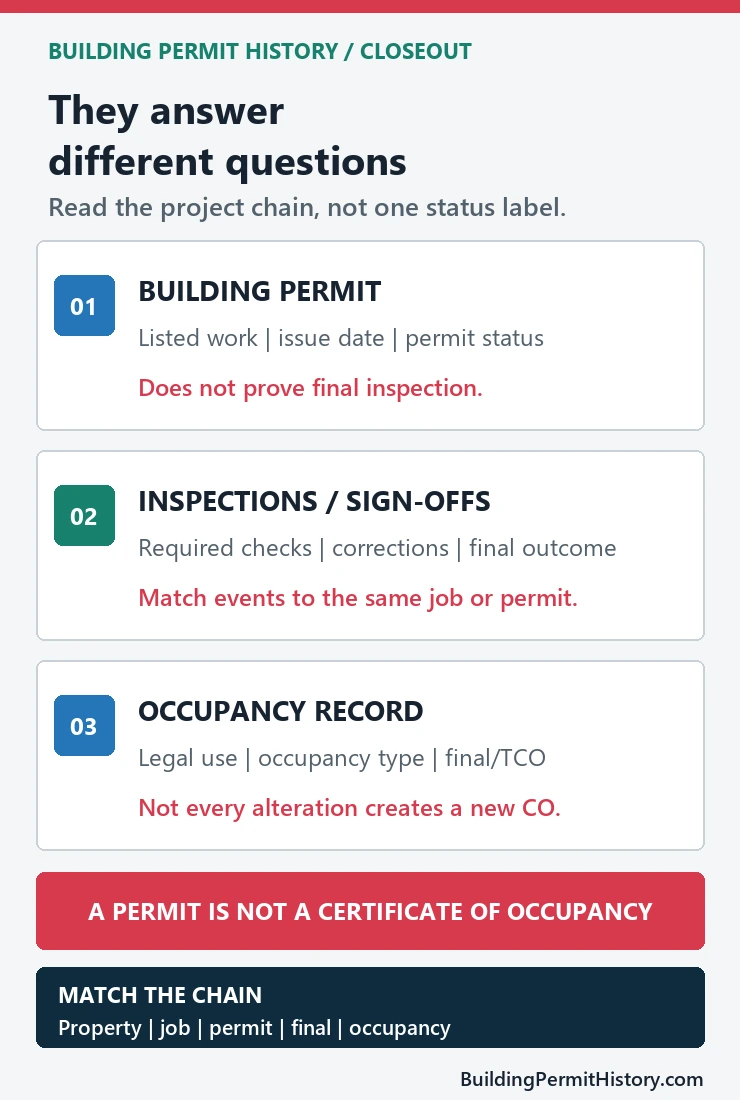
A building permit and a certificate of occupancy answer different questions. A permit is the authority to perform the specified work under the issuing jurisdiction’s conditions; an occupancy certificate records approved use or occupancy after the required closeout steps for the scope that needs that document. Search the permit and its inspections first, then locate the CO, temporary CO, Letter of Completion, or local equivalent that belongs to the same property and project.
Reviewed August 26, 2026 against the current New York City permit, project-closeout, and certificate-of-occupancy sources cited below.
Place each document at the correct project stage
| Record | Project-stage question | Fields to match | It does not answer by itself |
|---|---|---|---|
| Application/job | What work was proposed and reviewed? | Job/application number, address, scope, applicant, filed status | Whether work was authorized to start |
| Building or trade permit | What specified work was authorized? | Permit number, work type, scope, issue/expiry dates, permit holder | Whether the work was performed or passed final inspection |
| Inspection/sign-off | What required check occurred for that permit? | Permit/job number, inspection type, date, result, outstanding item | Whether another trade or occupancy prerequisite is complete |
| CO/TCO or local occupancy document | What use or occupancy did the authority approve for the stated building, floor, or space? | Property identity, certificate number/type, issue date, floor/use/occupancy details | Whether later alterations and permits are closed |
| Letter of Completion or local closeout | Was minor work closed where a new or amended CO was not required? | Job/permit number, scope, sign-off, issued date | A change in legal use outside that closeout scope |
The labels and legal effect vary by jurisdiction. Some authorities use temporary, partial, interim, conditional, or space-specific occupancy documents; others record a final inspection or completion letter for work that does not change the occupancy certificate. Report the authority’s exact document name instead of translating every closeout into “CO.”
Use New York City as a concrete record-chain example
NYC Department of Buildings publishes application, issued-permit, historical permit, and certificate-of-occupancy dataset families separately. Its project workflow places work permits before construction, required inspections and final sign-off at closeout, and a new or amended CO or Letter of Completion at the end. That sequence is why an issued permit cannot stand in for the occupancy record.
On the NYC Certificate of Occupancy page, a CO states the legal use or permitted occupancy type of a building. NYC requires a CO for new buildings and a current or amended CO when use, egress, or occupancy type changes. The page identifies final construction, plumbing, elevator, and electrical sign-offs; a final survey; resolved open applications and violations; required fees; and an approved Schedule of Occupancy among the CO prerequisites.
NYC has more than one legitimate closeout document
- Final CO: the final occupancy certificate for the building or covered occupancy schedule after applicable requirements are satisfied.
- Temporary CO: a time-limited occupancy document while specified closeout items remain; record its issue and expiration information from the live certificate.
- Letter of Completion: NYC may issue this for minor alterations that do not require a new or amended CO.
- Letter of No Objection: NYC describes this as a route to confirm legal use for a qualifying pre-1938 building that was not required to have a CO, subject to later changes in use, egress, or occupancy.
These NYC categories should not be imposed on another municipality. They show the decision method: determine which completion or occupancy artifact local law requires for the project, then retrieve that exact artifact.
Reconcile the permit and occupancy record by project identity
- Anchor the property with the official address and parcel/building identifier; keep unit, floor, suite, and building separately.
- List the parent job/application and every building or trade permit number associated with the work.
- Copy the approved work description, issued date, status, conditions, and permit-holder information from each permit.
- Record each required inspection or sign-off and identify the permit or project to which it belongs.
- Open the certificate or completion document and copy its number, type, issue date, property identity, and exact use/occupancy or closeout scope.
- Compare the certificate scope with the permitted work and flag later permits, floors, units, trades, or alterations not covered by that document.
| Reconciliation field | Permit side | Occupancy/completion side | Conflict signal |
|---|---|---|---|
| Identity | Address, parcel/BIN, job and permit number | Address, parcel/BIN, certificate or letter number | Different parcel, building, floor, suite, or job |
| Scope | Authorized work description and work type | Approved use/occupancy or completed alteration scope | Permit changes use but no matching amended occupancy record appears |
| Time | Issue/expiry and inspection dates | Certificate/letter issue date and TCO expiration when applicable | Certificate predates the relevant alteration |
| Closeout | Final inspections and sign-offs for each permit | Required certificate or completion artifact | Issued permit remains open or a required sign-off is absent |
| Later activity | Subsequent permits and applications | Current certificate and amendments | Later scope changes the space without corresponding completion evidence |
Read the most common combinations without overreaching
| Record combination | Bounded reading | Next official check |
|---|---|---|
| Permit issued; no final inspection | Work was authorized within the permit scope, but closeout is not shown | Inspection history, open requirements, and permit status |
| Permit final; CO not found | The named permit may be closed; determine whether that work required a new/amended CO or another completion document | Local occupancy rule and completion-document route |
| CO exists; later permit is open | The CO states the covered use/occupancy at its issue point; later work needs its own review | Later permit inspections, amendments, and current occupancy record |
| Temporary CO exists | Occupancy was allowed under the temporary document’s scope and time conditions | Expiration, outstanding items, renewal, partial/interim, or final CO |
| Older building has no CO | The absence may reflect the building’s age and local historical rule rather than a finding about legality | Legacy files and the authority’s alternate proof-of-use process |
| Address search is blank | That source layer returned no match for the entered identity | Parcel/building identifier, former address, legacy system, and records office |
Recover when the certificate cannot be matched
- Search the official property profile by both address and parcel/building identifier; multi-address buildings can hide records under another entrance.
- Check current and legacy systems. In NYC, search BIS for older property history and DOB NOW for newer filings and certificates.
- Open the parent job or application and look for a Schedule of Occupancy, certificate request, sign-off, or Letter of Completion reference.
- Inspect later alterations for a changed use, egress, occupancy type, floor, or suite that could require an amended record.
- Request the named certificate, completion letter, inspection sign-off, or permit folder from the local records custodian; include every known identifier and a date range.
- If the authority says a CO was not required, retain its written rule or issued alternate document with the property file.
Create a same-project closeout card
| Card line | Entry |
|---|---|
| Property | Official address, parcel/building ID, unit/floor/suite |
| Proposed work | Application/job number and full scope |
| Authorized work | Each permit number, type, issue/expiry dates, and conditions |
| Inspection chain | Required inspection/sign-off, date, result, and outstanding item |
| Occupancy or completion | CO/TCO/partial/interim/letter number, type, issue date, scope, and expiration if shown |
| Unresolved difference | Later work, unmatched scope, missing sign-off, or missing official record |
Use Final Inspection Status Check to verify the permit closeout sequence, Open Permits Check Before Buying to find later open work, and No Certificate of Occupancy for an Older Building for the legacy-document path. Neither a permit nor a certificate establishes the condition of every system today, and either document alone does not prove that later work is closed. The useful conclusion states the document, issuing authority, covered property and scope, issue date, and remaining gap.