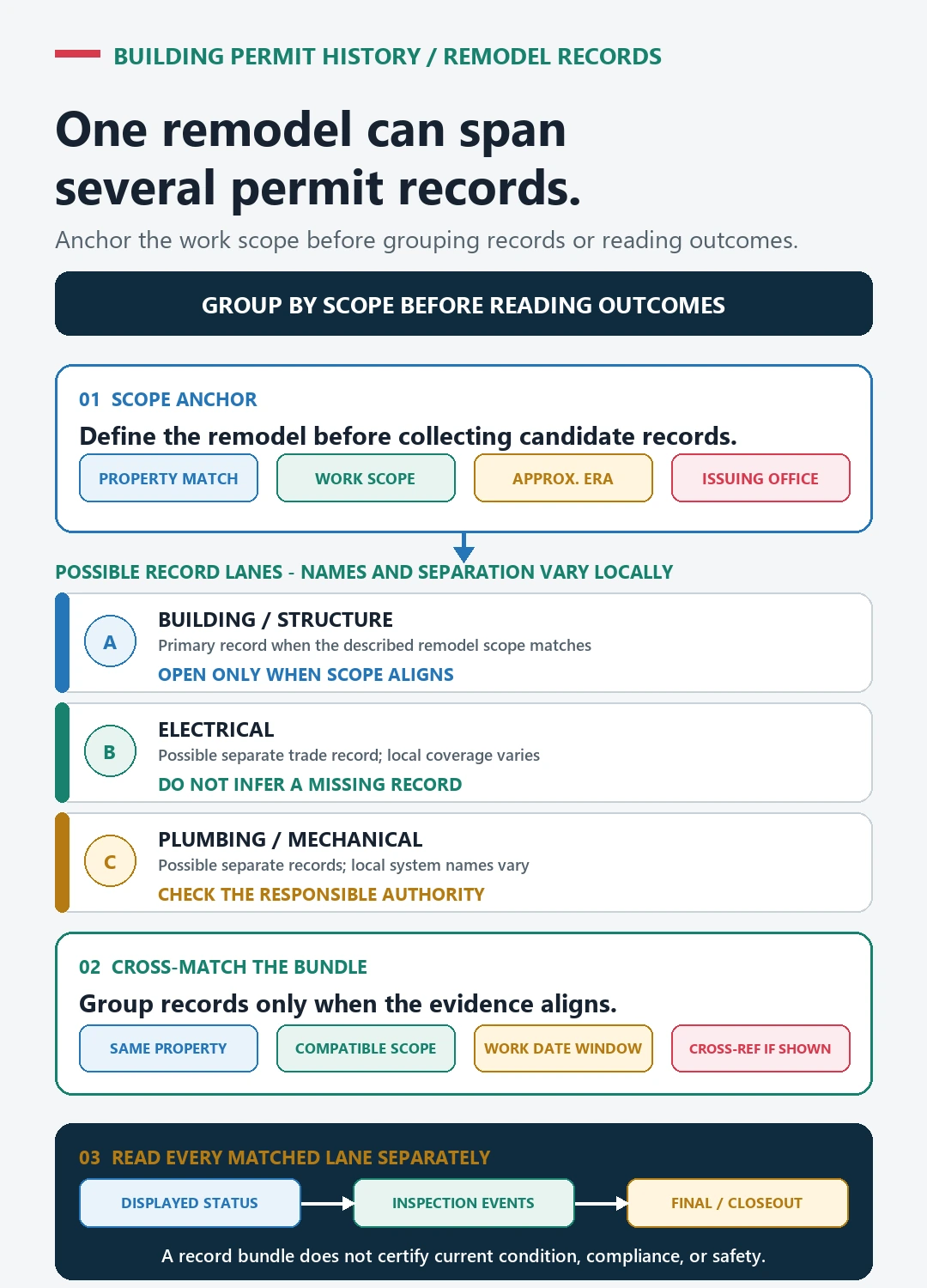
A remodel permit history check should answer three separate questions: what work the owner proposed, which permits the authority actually issued, and whether required inspections reached a closing result. An address result by itself answers none of those questions completely. Start with the room, system, and approximate work date, then follow each permit number through scope, related trade permits, inspections, and final status.
Official route checked August 26, 2026: City of Toronto, Toronto Building. Recheck the responsible local authority, Toronto’s current window, each permit number, related trade records and final-inspection field before relying on a remodel history.
Write the remodel facts before opening a portal
Describe the visible work in neutral terms. Record the address exactly as the authority recognizes it, the unit or suite, the parcel identifier if available, the approximate year, and the parts of the building that changed. A useful inventory separates structural alterations, additions, plumbing, electrical, mechanical, demolition, and changes of use. It does not begin by declaring the work legal or illegal.
Use photographs, seller disclosures, plans, invoices, and assessor descriptions only as search clues. They can narrow an era or identify a contractor, but they do not replace the issuing authority’s file. If the project involved several systems, expect several records. The site’s home renovation permit history guide explains how to turn a room-by-room change list into record searches.
Confirm the authority and the property identity
The permit custodian may be a city, county, borough, or another local agency. Confirm that the property was inside the authority’s boundary when the work occurred. Then search the official address vocabulary rather than the version shown in a real-estate listing. Try the main street number without a unit, the official directional, an accepted street suffix, and the parcel or roll number when the portal supports it.
Keep an identity card beside the results. It should contain the searched address, parcel, unit, former address if known, authority name, search date, and each variation tried. This prevents records from a similarly named street or an adjacent parcel from being mixed into the remodel history.
Use Toronto’s status tool as a worked example
The City of Toronto’s building permit application and inspection status page links to the official status application and explains its coverage. The city says the tool contains active permits that are ten years old or less from application, plus permits closed or cancelled for no longer than one month, and that information is updated as of the previous business day. That boundary is important: a missing older remodel is not disproved by a blank current-status search.
In the Toronto Building Application Status search, a user can search by application number, ward, or address and choose record types such as Building Permit, Zoning Review, or Issued Orders. Start broad enough to catch the property, then refine if the result limit is reached. Save the application number from every plausible row because the number is the stable join key for later review.
Reconstruct the application-to-permit chain
For each candidate result, capture the application date, permit type, work description, current status, issue date, and any revision identifier. An application that was received or reviewed is not the same as an issued permit. Likewise, an issued permit is not proof that the work passed final inspection.
Compare dates in sequence rather than judging one label in isolation:
- Application received shows that a proposal entered the system.
- Review or notice activity shows that the proposal was being examined or corrected.
- Permit issued shows that work could proceed under the approved scope.
- Inspection events show which stages the authority recorded.
- A final or closed result shows the file reached the authority’s closing step.
If the sequence skips a stage, mark the missing field. Do not silently fill it with an assumption. The permit number lookup guide provides a method for carrying one identifier across related screens.
Compare the approved scope with the observed remodel
Read the work description literally. A permit for replacing fixtures does not necessarily cover moving plumbing, and an interior alteration entry may not cover an addition. Record the rooms, floor area, structural elements, and systems named in the official description. Then place the observed work beside those elements in a simple scope table.
Use three findings: matched, not stated, and unclear. Matched means the record text expressly describes the element. Not stated means the element is absent from the retrieved scope. Unclear means the description is too abbreviated to decide and the approved plan or job card is needed. This wording preserves the difference between a record gap and a code conclusion.
Join building and trade permits
A remodel can have a parent building permit and separate plumbing, electrical, mechanical, gas, or fire records. Search the same address and date band for each record family. Look for related-record links, shared project descriptions, contractor names, or application numbers. Do not assume every portal automatically displays all related files.
For each trade record, copy the permit number, trade type, issue date, inspection events, and closing field. The plumbing, electrical, and mechanical permit records guide explains why a completed building record can coexist with an unresolved trade record. If the remodel included a panel, furnace, water heater, or relocated fixtures, that branch deserves its own check.
Read inspections without overstating them
Inspection labels describe the authority’s recorded event, not the present condition of concealed work. Distinguish requested, scheduled, passed, failed, cancelled, partial, final, and closed. A passed rough inspection may apply only to work visible at that stage. A final inspection may still be missing, or a related trade permit may remain open.
Toronto’s status glossary separates review, issue, and inspection states and notes that owners must schedule a final inspection to close a permit. Use the site’s final inspection status check when a result says issued or inspection but does not show an unmistakable closeout. Record the exact status text and checked date because portal labels can change later.
Recover records outside the online window
When the remodel predates the portal’s stated coverage, move to the authority’s historical index, scanned permit cards, property file, microfilm, or records request route. Ask for a narrow record family and date range rather than all documents for the address. Include the official address, former address, parcel, approximate remodel year, owner at that time if known, and any permit number fragment.
A no-hit log should show every system searched, its stated coverage, the inputs used, and the response. That log makes the next request more precise and stops a current database from being treated as a complete archive.
Finish with a remodel evidence memo
Summarize each project as a chain: property identity, application, issued permit, approved scope, related trades, inspection history, closeout, and unresolved documents. Attach screenshots or saved records with the access date. State what the authority’s file supports and what remains unknown.
The final sentence should be narrow. For example, the retrieved record supports an issued interior-alteration permit and a recorded final inspection, while the electrical branch still needs confirmation. That is more useful than saying the whole remodel was permitted, and it gives an owner, buyer, inspector, or attorney a specific next action.