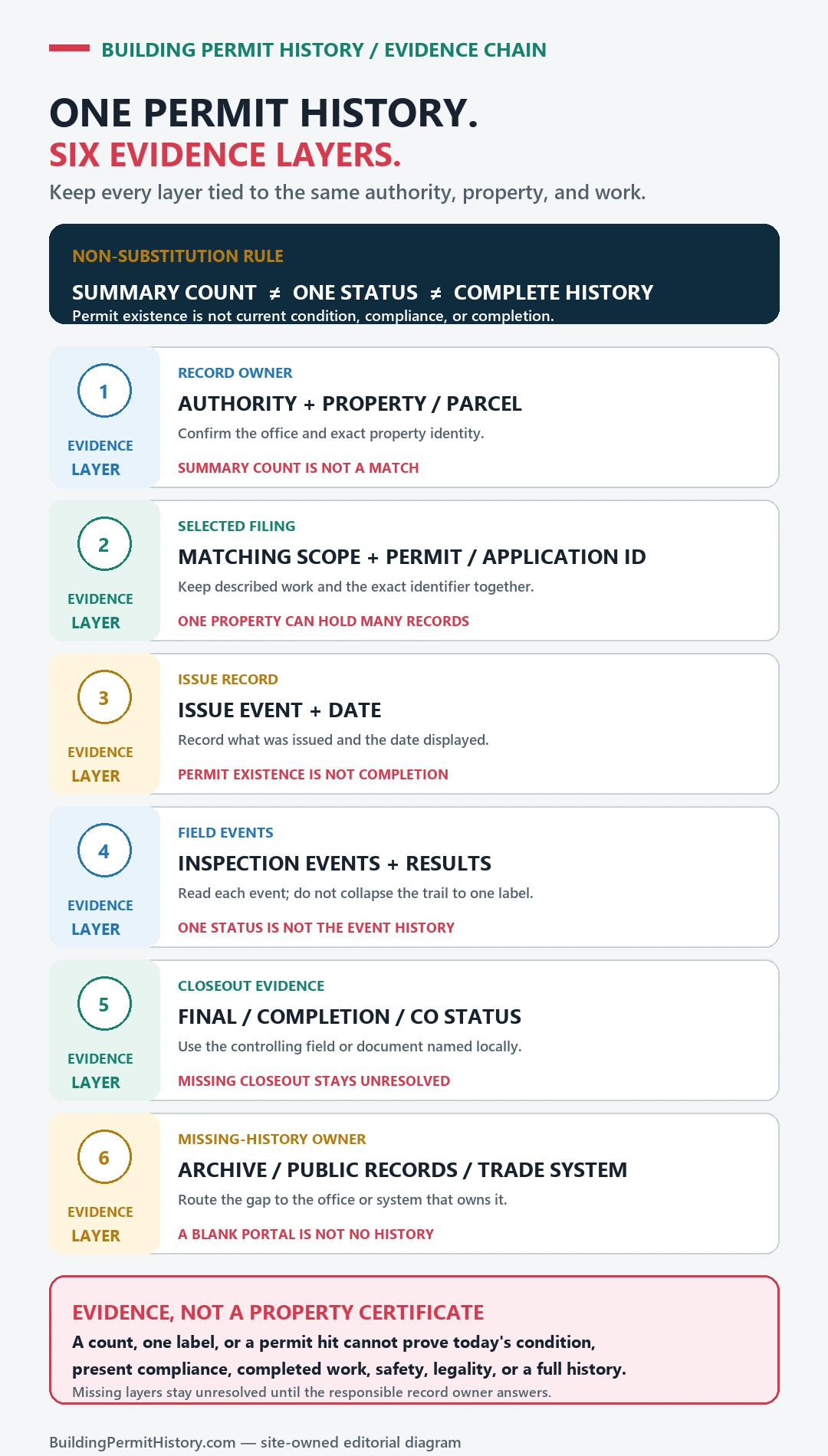
A building permit record usually identifies the issuing authority, property, permit or application number, work description, key dates, named project roles, and current status. Some systems also expose plan-review events, related trade permits, inspections, correction notices, documents, and a final or closeout event. A property summary or permit count does not show that full chain.
The record describes what the authority received, issued, inspected, or closed in that system. It does not by itself prove that every visible change was permitted, that the work matches the approved plans, or that the property complies today.
Find the authority that created the record
Start with the city, county, town, or other local department that had permitting authority when the work occurred. If that office is unclear, use the USA.gov local government directory, then confirm jurisdiction on the department’s own site. Search with the official address and parcel identifier; keep the approximate work date and any permit or application number ready for an archive or records request.
- Property match: official address plus parcel, lot, or building identifier.
- Project match: work description, record number, applicant or contractor role, and issue date.
- Outcome match: inspection entries, corrections, final status, and any certificate tied to the same scope.
- Coverage check: the system’s date range, excluded record types, and route for older or non-digitized files.
Use both the address and parcel number
To complete the building permit records review, have the street address, parcel number, owner or applicant name, permit number, and an approximate work date ready.
- Exact street address
- Parcel or assessor number
- Permit or application number
- Issuing city or county
Open the permit, inspection, and completion history
- Open the individual permit or application record that matches the property and work description.
- Copy the issuing authority, record number, permit type, scope, issue date, and agency status exactly as displayed.
- Follow related permits, inspections, corrections, documents, and any final or certificate record tied to the same work.
- Check the source’s published coverage before interpreting an older or missing record.
- If a layer is absent, ask the issuing office for that named record and preserve the search terms and date used.
Read issued, finaled, expired, and open separately
Before relying on the building permit records review, the result is strongest when the permit, inspection events, and final status refer to the same scope of work and property.
| Record element | What it can tell you |
|---|---|
| Property identity | Which address, parcel, lot, or building identifier the record is attached to. |
| Scope and dates | What work the filing describes and when application, issuance, or later events were recorded. |
| Status and inspections | The agency’s recorded stage and any inspection results shown for that exact record. |
| Closeout or certificate | Whether the source shows a later final, completion, or occupancy document tied to the same scope. |
A permit entry found through building permit records does not by itself prove that the work passed final inspection, matches the building today, or complied with rules owned by another department.
If the permit history is incomplete
For an unresolved record, give the issuing office the official address and parcel identifier, approximate work year, exact record type needed, portal or archive searched, search values used, and every application or permit number found. Ask which system or request route owns that named item.