For one Chicago property, start with the City’s Building Permit Application Status search. An address search returns limited information for applications received within the last 36 months; the City’s application status help says fuller monitoring details require the exact application number. Match that application to the address, applicant, work description, and application date before reading its status.
Use the Chicago Building Permits dataset as a separate official surface for issued-permit history, not as a substitute for application detail. A dataset row does not prove the work began, passed inspection, or reached final completion. For a login-free example, use the small official address-filtered CSV below to compare two permits at one library address.
Two permits at 6120 S Kedzie Avenue, two different answers
On October 4, 2026, we used AI-assisted remote retrieval to query and compare the City’s public permit data for 6120 S KEDZIE AVE. The newer record describes work at a Chicago Public Library. This was a direct anonymous data lookup, not a site visit or a search in the separate Application Status portal.
You can reproduce the lookup with this small official CSV for 6120 S Kedzie. It uses three exact fields: STREET_NUMBER = 6120, STREET_DIRECTION = S, and STREET_NAME = KEDZIE AVE. In this dataset, AVE is part of the street-name value; S is a separate direction. The link requests at most 25 rows, newest issue date first. Our matching JSON query returned two records, and a separate count query confirmed two matches. We also checked that the CSV values matched.
| Permit number | What the returned row says |
|---|---|
| 101079671 | Issue-date field: March 27, 2026. Renovation/alteration: HVAC upgrades and associated electrical work for the library. Status ACTIVE; milestone INSPECTIONS. |
| B100747876 | Issue-date field: April 3, 2018. Low-voltage installation; currently classified as Express Permit Program. Status COMPLETE; milestone COMPLETE. |
The older row cannot close out the newer HVAC work: they have different permit numbers, dates and authorized scopes. Keep the B in B100747876 when copying it. Also distinguish the newer row’s database ID, 3440389, from its PERMIT#, 101079671; the City’s field descriptions identify the former as the database row identifier and the latter as the tracking number assigned when the permit application process begins.
Dates need the same care. The newer row’s application-start field is February 23, 2026, while its issue-date field is March 27. The City defines ISSUE_DATE for most permit types as the date a permit was ready to issue, subject to fee payment; Express Permit Program rows have a payment-based issuance definition. Neither field establishes when construction began. We did not check payment receipts.
ACTIVE / INSPECTIONS is not a final-inspection pass. Nor does the older COMPLETE / COMPLETE row establish that the later work is finished. This query retrieved no inspection event dates, pass/fail results, inspection report or occupancy certificate. The status and milestone fields are not available for every permit type, according to the City; an absent value would remain unknown, not a passed inspection.
For your own address, preserve all three street fields and copy the returned permit number with its scope. If nothing matches, check the primary address used for a building with an address range—the City notes that its street-number field uses that primary address. These two results are complete for our exact filter at the check time, not a complete history of the site. The dataset description covers issued permits from 2006 onward and says permits later voided or revoked are excluded. Address variants, earlier work and inspection documents still require separate investigation; absence is not evidence of unauthorized work.
Use address search only for recent application discovery
The City says an address search returns limited information for applications received within the last 36 months. Use it to find a candidate application, then search the exact application number for fuller monitoring details. Use the issued-permit dataset separately when the question is permit history rather than recent application review.
- Building Permit Application Status
- application status help
- USA.gov local government directory
- Chicago Building Permits dataset
Match the application to the property before reading status
For the recent-application tool, keep the exact application number, street address, applicant, work description, and application date together. For issued-permit research, use the dataset’s property and permit fields as a separate match; do not substitute a permit number for the application number required by the application-status tool.
Permit descriptions are useful clues, but they can be abbreviated, applicant-supplied, or limited to the authorized scope. A record for electrical work does not prove a full renovation was permitted. A renovation permit does not automatically establish a new occupancy, legal dwelling unit, or completed structural work. Compare the permit type and description with the specific feature being checked, then look for related permits under the same address and time period.
Open the permit, inspection, and completion history
- Use the address search to discover recent applications within the tool’s 36-month window.
- Open fuller monitoring details only with the exact application number.
- Match the application address, applicant, work description, dates, review steps, holds, and issued status.
- Search the Chicago Building Permits dataset separately for issued-permit history and keep its permit number and issue date distinct from the application record.
- Verify inspection or closeout through the relevant City record path; neither an application milestone nor a dataset row proves final inspection.

Read issued, finaled, expired, and open separately
Before relying on the Chicago permit search, the result is strongest when the permit, inspection events, and final status refer to the same scope of work and property.
| Record field | How to read it |
|---|---|
| What permits were issued for this address? | Chicago Building Permits dataset: Address formats vary, and later project events may need separate checking. |
| Where is a recent application in review? | Building Permit Application Status: Address searches show more limited information than an application-number search. |
| Was work inspected or closed out? | Relevant inspection and building-record sources: An issue date or work description is not a final inspection. |
| Is the present use legal? | Zoning, occupancy, permit, and other city records: One historical permit cannot settle every current-use question. |
A permit entry found through Chicago building permit search by address does not by itself prove that the work passed final inspection, matches the building today, or complied with rules owned by another department.
How Chicago’s permit volume changed, 2021–2025
An address search remains the right way to investigate one property. For citywide context, Building Permit History grouped rows in the City of Chicago Building Permits dataset by the dataset’s ISSUE_DATE for five complete calendar years. Rows whose current PERMIT_STATUS was CANCELLED or REVOKED were excluded.
| Issue year | Filtered permit records | Change from prior year |
|---|---|---|
| 2021 | 39,098 | — |
| 2022 | 38,308 | −2.0% |
| 2023 | 34,372 | −10.3% |
| 2024 | 33,433 | −2.7% |
| 2025 | 32,021 | −4.2% |
ISSUE_DATE from 2021 through 2025. Current CANCELLED and REVOKED statuses were excluded.The row count was 18.1% lower in 2025 than in 2021. These are permit rows, so the drop does not measure construction starts or completed projects. For how permits issued in 2023 and 2024 ended, see the next section.
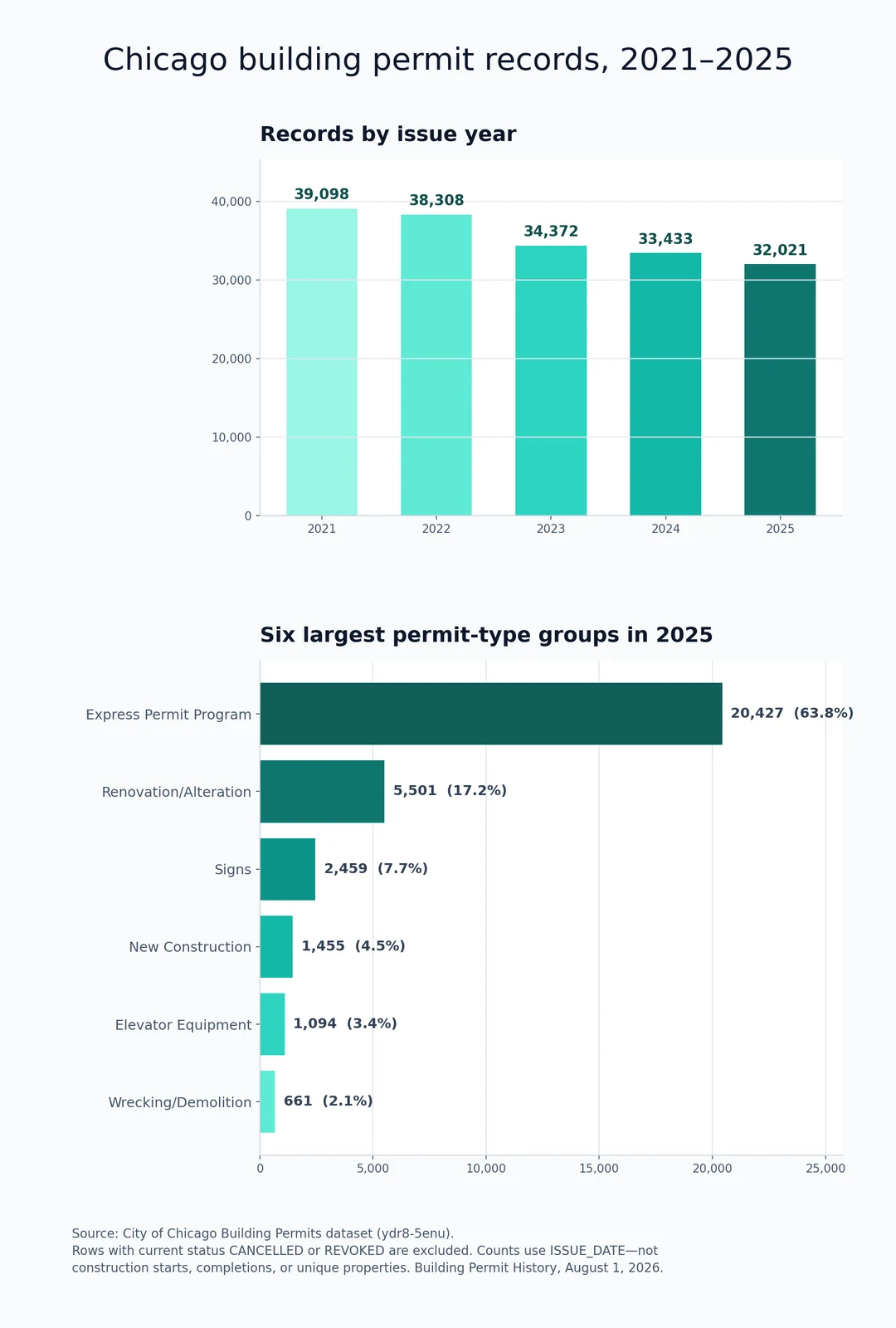
ISSUE_DATE, with current CANCELLED and REVOKED statuses excluded. The 2025 type shares use the same filter. Source checked and aggregation generated August 1, 2026.Method note: Rows are permits, not unique properties, and an issue date is not a start date or a final inspection.
What 67,828 recent Chicago permits show about expired renovations
We downloaded every Chicago building permit issued in 2023 and 2024 from the city’s open data set (City of Chicago Building Permits, pulled October 23, 2026) and compared review time and current status by permit type. That is 67,828 permits. The city publishes a status only for some permit types, so easy permits, signs, and elevator permits are left out of the table below. The numbers are our own calculation from the city’s records, not figures published by the Department of Buildings. Our Los Angeles and Chicago comparison breaks 2022 residential renovation permits down by project type.
| Permit type (city category) | Permits issued 2023–24 | Days from review start to issue (median) | Now “Complete” | Now “Expired” |
|---|---|---|---|---|
| Renovation/alteration, standard plan review | 7,306 | 63 | 36% | 37% |
| Renovation/alteration, self-certification | 4,958 | 9 | 42% | 31% |
| New construction | 2,468 | 34 | 51% | 21% |
| Express Permit Program | 33,956 | 1 | 84% | 0% |
Three things stand out for anyone checking a Chicago house before buying.
- Renovation permits expire about as often as they finish. Of 12,613 renovation/alteration permits issued in 2023 and 2024, 34% now show “Expired” and 39% show “Complete.” For those issued in 2023, Expired (45%) outnumbers Complete (42%). Almost all of the expired ones (4,037 of 4,261) still list “Inspections” as their last milestone, meaning the permit lapsed before the city recorded it as complete. That is the record to raise when a listing mentions a recent renovation.
- Faster approval doesn’t mean a closed permit. Self-certified renovations were issued in a median of 9 days, against 63 days under standard plan review, yet their expired share was nearly as high (31% against 37%). How a permit was reviewed tells you little about whether the work was inspected to the end.
- Smaller renovations expire most, as in Seattle. For renovations reported under $10,000, 45% now show Expired, falling to 38% at $10,000–50,000, 34% at $50,000–150,000, and 28% above $150,000. That matches the pattern in our Seattle permit analysis. Express permits never show Expired in this data, but 14% (4,786) show “Suspended,” including 23% of express reroofing permits. The city’s data doesn’t define Suspended, so ask the Department of Buildings what that label means for a specific permit.
Limits of this count: status and milestone are the city’s current fields on the pull date, and the city notes they are not available for every permit type. Review days use the city’s own processing-time field, which runs from the date the city began review to the issue date. Reported cost is the applicant’s figure. Rows are permits, not unique properties, and voided or revoked permits are not in the data set.
Pick a city, a type of work, and a year. See how long similar permits took to issue and how many never recorded a final inspection.
To compare Chicago’s wait with other cities, see our data on how long building permits take in six places.
If the permit history is incomplete
For an unresolved Chicago record, preserve the street address, PIN when available from an official City record, work year, record type, exact application number if known, permit numbers found, and whether Application Status, the Building Permits dataset, or another City record path was searched. Ask the City for the named application, permit, inspection, or closeout record.
If the address has a building violation for work without a permit, our Chicago building violations lookup shows how 1,446 such citations from 2024 ended, including how often a permit followed and what happened at Administrative Hearings.
Related guides
- permit lookup by address guide
- building permits as public records guide
- Building Permit Records Official Database: Official Permit Record Checks
More from our permit data: what public permit records show across seven places.