To investigate possible unpermitted work, compare the present property with official permits, approved plans, inspection records, certificates, and code-enforcement documents. A missing permit record does not establish that work was illegal, and a permit found at the address does not establish that every visible alteration was within its approved scope. The task is to build a dated evidence gap.
Official route checked August 26, 2026: Los Angeles Department of Building and Safety; Recheck PRISM’s current search coverage and obtain the applicable LADBS document or certified copy before classifying a record gap.
Los Angeles PRISM is a useful official example because it supports address, parcel, legal-description, assessor-number, and document-number searches and brings construction, permitting, inspection, occupancy, and enforcement documents into one research route. Use the same evidence logic with the actual jurisdiction that owns the property records.
Describe the observed change before searching
Write a neutral inventory of what appears different: added room, converted garage, moved wall, new bathroom, electrical panel, plumbing fixture, HVAC unit, deck, roof structure, window, exterior door, second unit, or changed occupancy. Record approximate dimensions, location, materials, and any seller or contractor date claim. Do not label the work unpermitted at this stage.
Separate the observation from the record question. The record question might be whether a 2018 permit authorized an addition of a stated size, whether a final inspection was recorded, or whether a certificate reflects the current number of dwelling units. A precise question can be matched to a precise document.
Use the home renovation permit history guide to organize the project clues without turning them into a legal conclusion.
Search Los Angeles PRISM by more than one identity
Open LADBS PRISM from the Los Angeles Department of Building and Safety. The public module accepts an address, parcel or assessor number, legal description, and document number. Its advanced route also supports non-parcel terms such as a case, receipt, project, disaster, film reel, or document type.
Start with the normalized address, then repeat with the assessor parcel number. If the property has a known tract, block, lot, or document number, run that search independently. Save the selected parcel and result count after each pass. A renamed street, changed numbering, assembled lot, or range address can split relevant documents across searches.
Do not use a loose address resemblance as the match. Confirm the parcel or legal description before connecting a document to the observed work.
Build a timeline from document type and date
The PRISM help page describes scanned permits, plans, certificates of occupancy, and related Department records. Use the date filters and table filters to group results. Create one row per record with document number, type, status when shown, address or legal identity, recorded date, project description, and link.
Arrange the rows in this order:
- Application or plan-check record
- Issued building or trade permit
- Approved plan or revision
- Inspection and correction record
- Final approval, certificate, or completion evidence
- Code-enforcement notice, order, or resolution
Chronology matters. A later permit may legalize, replace, or alter earlier work, but the later date alone does not prove its scope covers the observed condition. Open the document.
Compare approved scope with the physical clue
Copy the work description and dimensions from the permit and plan. Match them against the location and type of the observed change. A permit for interior nonstructural work should not be used as evidence for an exterior addition. A plumbing permit may support listed plumbing work but not a structural conversion. A main permit may have child electrical, mechanical, or plumbing records that need separate review.
Use the trade permit record guide when utilities or equipment are part of the clue. Record whether each trade record is applied, issued, inspected, corrected, or final according to the local fields.
Classify the comparison as matched scope, partial match, conflicting scope, or no matching document located. These are research findings, not declarations of legality.
Keep inspections and occupancy evidence in separate branches
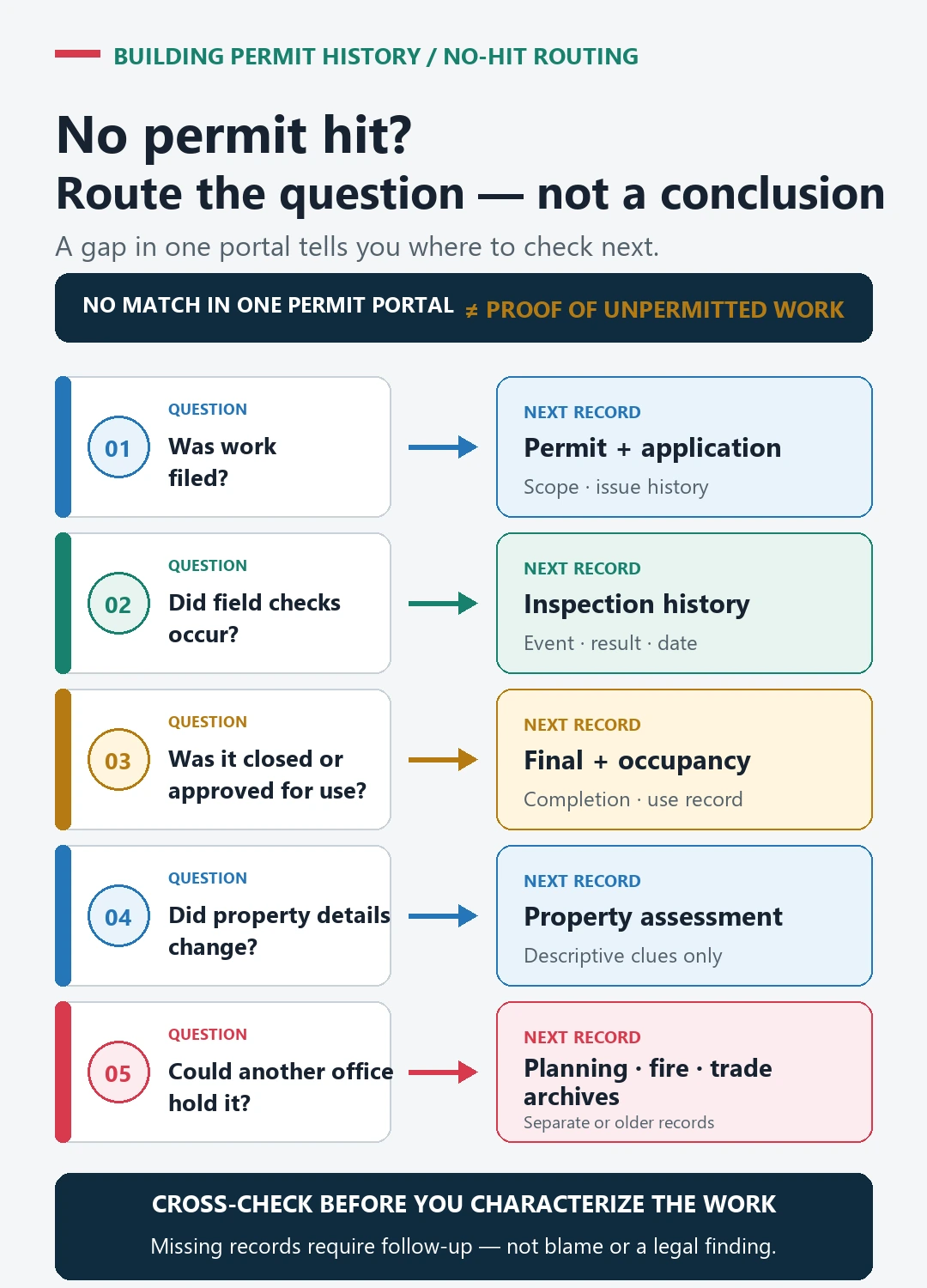
An issued permit authorizes stated work subject to its conditions. Inspection records show what the department recorded at stages of the work. A certificate of occupancy or similar record addresses use or occupancy under local law. One does not replace the others.
For a room addition or conversion, look for required inspections and a final result. For a claimed new dwelling unit or occupancy change, compare the permit chain with the relevant certificate or occupancy record. The permit versus certificate guide keeps those decisions apart.
If a permit is final but the present layout differs from the approved plan, preserve the discrepancy. If a certificate exists but later structural work lacks a matching permit, preserve that later gap as a separate question.
Request the named missing record from LADBS
PRISM states that the LADBS Records Section provides Department-issued construction, permitting, inspection, and code-enforcement documents. Its help page directs users seeking official or certified copies to the Records Section and advises contacting that section when an expected record is missing.
Prepare the address, assessor number, legal description, date range, known document numbers, observed-work description, and exact record requested. Ask for the permit card, approved plan, inspection record, certificate, enforcement file, or other named document. A request for everything can be slower and may still omit the item needed to resolve the comparison.
Record the request date, custodian, response, search limitation, redaction, and any archive or in-person route provided.
Classify the gap before deciding what to do
Use four categories:
- Record match: The official scope and property identity align with the observed change
- Incomplete chain: A permit exists but plan, inspection, final, or certificate evidence is missing
- Identity conflict: Address, parcel, legal description, or work location does not align
- No matching record located: The checked official systems and request did not produce a matching document
The last category is not proof that no permit ever existed. It documents the search performed and the unresolved gap. Work may predate online coverage, use a former address, appear in a parent project, or sit in a file not yet digitized.
Ask a narrow agency question
Send the department the property identity, observed change, candidate permits, missing links, and checked dates. Ask which record, if any, authorizes the described work and what official process is available when the record cannot be reconciled. For a transaction or planned construction, coordinate the answer with the appropriate qualified local professionals.
The final packet should separate facts, records, and unresolved questions. It is not a substitute for a site inspection, code determination, title review, or official legalization process. Its value is showing exactly where the present condition and the official record do or do not connect.